
No products in the cart.
Return To Shop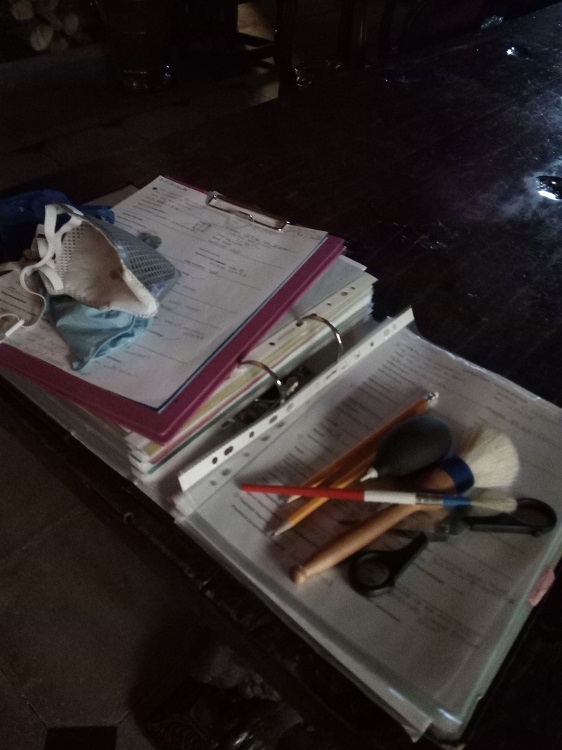
A Day in the Life of a Curator
When I tell people I work part -time in a Castle I often get asked what it is I actually do! As Head Curator at Muncaster Castle, I work with a fabulous team consisting of two Assistant Curators and a band of staff and volunteers and I’d like to give you an insight into the kind of tasks we might be faced with during the course of a “normal” day.
My day begins with a walk down the Drive from Main Gate. No matter what time of year it is, there is always something new to see. In the winter, the snow and frosts transform the trees and lawns into a sparkly wonderland.

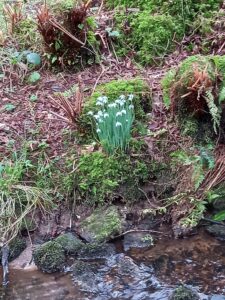
The Hellebores herald the start of spring as their heads gently nod in the chilly wind whilst snowdrops and the native daffodil give a vernal freshness to an otherwise sleeping garden.
Come April, the colour bursts forth, with the first azaleas and rhododendrons and by the time I reach the Clocktower of the Castle itself, the Mighty Magnolia down in the Ghyll, possibly the largest in the UK, is creamy white with its waxy flowers.


The first job of the day is to “open up” and as I go from room to room opening the window shutters, I pause to take in the views from each of the windows. I love this time of day; the Castle is silent and it’s hard not to let your mind wander towards the people who were here throughout the last 800 years.
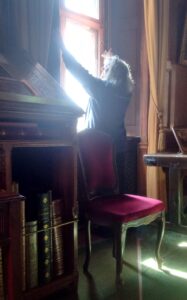
The daylight highlights the next task in hand. Dusting the surfaces gives us chance to check on the condition of the artefacts. We don’t “dust for dusting’s sake” but if a finger trail can be seen then it qualifies.
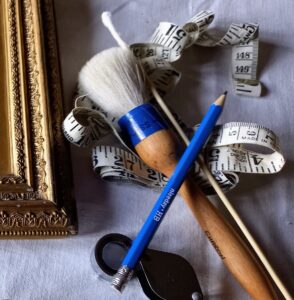
Whilst we employ general housekeeping methods for the robust aspects of the room, floors, skirtings etc. we must also use specialist cleaning techniques with particular artefacts, using not dusters but brushes and a conservation vacuum cleaner.

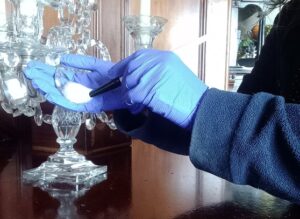
Pest monitoring is a very important part of collection care. Identification, is it a moth? If so what kind? What does it eat? What is its breeding cycle? How do we prevent infestation? What do we do if we find infestation?
There are a number of pests who think our artefacts are yummy! Moth, carpet beetle, woodworm, silverfish and booklice are the most common. Each has its own preferred habitat, diet, breeding cycle and environmental conditions, so we need to be vigilant and thorough with our cleaning and recording.
Environmental monitoring, therefore, plays a large role in the Castle. We have instruments which monitor humidity, temperature and light. Fluctuations above the norm of any of these factors can prove detrimental to the collection. It can be a balancing act trying to reconcile the needs of the artefacts against the comfort of the visitors and the enjoyment of everyday life for the family who live at Muncaster.
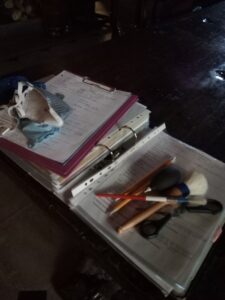
Another aspect of our work is to catalogue the artefacts in the collection so that we know “”where it is, what it is and how to care for it.
Any damage is recorded, along with photographs and any information about its provenance.
It is fantastic to look at an artefact and know that it was gifted as a birthday present to a member of the family in the 19th century, because a member of our team had just discovered the entry that tells us so in a diary!
Research is vital and our volunteers spend hours transcribing diaries and letters and tell me that they grow to “know” their subjects intimately. We receive requests for information not only about our artefacts from academics but also about the family ancestors and staff records from people tracing their own forebears.
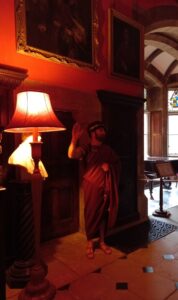
Sometimes we have temporary displays within the rooms. Recently we participated in HW1900, a countywide project surrounding the 1900 year anniversary of Hadrian’s Wall. We turned our Guard Room into a Roman Museum for the season. This involved lots of research, display and interpretation of the artefacts found near the Castle and from excavations in Ravenglass and reproducing Roman games for visitors to play. Peter became “Emperor Hadrian” for the duration of the project after opening the proceedings by enjoying a bubble bath at the Roman Bath house in Ravenglass on a freezing January morning!
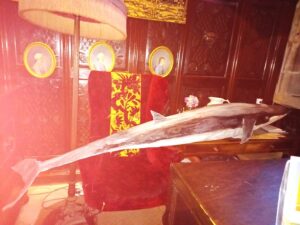
This year’s display is to be “The Coast” and my colleague has made a rather large exhibit for it. There is nothing more surreal than coming into work and finding a 9ft whale on the Great Hall floor then with it under my arm, looking for a suitable place to put it before visitors arrive !
We take each day as it comes, and nothing surprises us anymore! From “Flog It” to “Top Gear” and “Halloween” to “Sausage Fest” and “Dragcaster” things like this are “normal Muncaster” if ever there was such a thing !
Expect the unexpected and especially those things that cannot be explained… lights going on and off on their own, the invisible man knocking on doors, all things electronic rendered useless at the drop of a hat, whispering in corridors and the sense that someone wants to play.
Tom Fool or Thomas Skelton, Muncaster’s 17th century jester usually gets the blame for everything and some of us have a ritual of greeting him “Good Morning” by way of guarding against mischief during the day! My colleague forgot the other morning and had two small stones cast at her at such force they stung her neck !!! Tom likes to tease her because on another occasion, she was vacuuming the landing when the hoover stopped abruptly, she returned to the plug socket beneath Tom’s portrait to find the plug in place and the socket still switched on. My colleague berated Tom in no uncertain terms to stop messing as she had to get away early and at which the hoover immediately started up again.
Those of us who have been at Muncaster a long time tend to dismiss the strange “goings on” as them being “Just Tom” and continue to placate the jester with a cheery salutation. Our visitors always ask if the Castle is haunted, but we ask them to give us their opinion about it when they leave, so not to influence their experience. For the brave we continue to offer “Ghost Sits” where they can stay overnight in the Tapestry Room………………………. usually, they have left by the time I arrive for work!
And of course, we do open to the public for most of the working day so delivering a “Curators Chat” and answering questions is all part and parcel of the day. We love the questions people ask, especially the children….” How many walnuts did it take to make that table?” one little boy asked ….”where is the rest of it?” a little girl asked of the skull of the lion… . “ These rooms are really big, did giants live here?”
With the Visitors also comes the extra dusting, increased humidity (unlike our ghosts, our Visitors need to breathe!) and the front door is open so grit, grass, leaves and sometimes pests are all transported onto the floors. Despite this, we do love the people who come to see us from far and wide and could not survive without them, so a bit of extra cleaning and preventive measures are well worth the effort.
At the end of the day the Visitors leave, and the doors are closed. We vacuum all the floors, shut the shutters, turn off the lights and do a final check of emails and the diary …………………………
………… which shows that the next day we have a school group wanting an educational session and a coach party needing afternoon tea!
My Curator job is rarely boring, I get to manage beautiful things, in a building steeped in history, in an amazing part of the world. I meet people from all walks of life, most have a story to tell as we exchange information as we chat. There is more to discover and new stories to be told as we are day by day still building our archive and continue to catalogue documents held in store.
Life as part of a Curatorial team is interesting, rewarding, fascinating and there is never a dull moment and when I visit an historic house or museum I am not necessarily looking at the same things as you!
Sharon Arrowsmith info@cumbriantreasures.co.uk www.cumbriantreasures.co.uk
About author
