
No products in the cart.
Return To Shop
Palaeozoic, Permian, turbidites, breccias, porphyritic, vesicular, bedding and cleavage planes …
I might once have said “it’s all Greek to me,” but a fascinating study day last week led by geologist Dr. Danny Clark-Lowes was a hugely enjoyable way for Cumbria’s Blue Badge Guides to build on our existing knowledge of local geology and further our understanding of ways in which man has been able to make practical use of the area’s huge variety of geological materials.

Our base for the morning was the Blencathra Field Studies Centre, located at 300m above sea level with stunning views to the south. In the early 1900s this location was deemed an ideal spot for one of the first sanatoria in England – an isolation hospital for tuberculosis sufferers, which, when opened by the Countess of Lonsdale in 1904 boasted “perfect drainage, ample shelter, sufficient isolation and a stunning view.”
It’s also a perfect location to study the geology of the area, for it was here, in the Keswick area, that the story of Cumbria as we know it began 500 million years ago, with the formation of the Skiddaw Group rocks; to put that into perspective, dinosaurs first evolved about 230 million years ago, and the largest mountain range in Europe, the Alps, was formed about 65 million years ago.
Looking to the south towards St John’s in the Vale and 5,000 year-old Castlerigg Stone Circle, we were looking at a younger landscape created as a result of violent volcanic explosions 450 million years ago. Imagine red-hot lava flows and ash clouds tens of kilometres high! Those are the “Borrowdale Volcanics”: the next oldest of the three main bands of rocks that make up the central core of the Lake District, including England’s highest mountain, Scafell Pike.

The youngest of these three main bands are the rocks of the Southern Fells (“only” 420 million years old). If you picture England’s largest natural lake, Windermere, the head of the lake at Ambleside sits within the volcanic belt, and the southern reaches of the lake sit within a gentler landscape. Like the area around Keswick, the rock here is termed “sedimentary” – literally sediment laid down in shallow and deep seas.
Around the central Lakes is a limestone band: laid down on the sea bed 300 million years ago, this rock is made up of skeletons of sea creatures, which can be polished to give it an appearance similar to that of marble. And then there are the coal measures of the Carboniferous period and the red sandstone dating back to a time when desert conditions prevailed. All-in all, what a fine cocktail of different rocks we have here, which have also been affected by periods of mountain building and glaciation.
With that in mind, it’s no surprise that two of the country’s pioneering 19th century geologists came from Cumbria: the “Father of Lakeland Geology,” Jonathan Otley (whose former clock- and watch- repair business was tucked down an alleyway in Keswick), and Adam Sedgwick, Professor of Geology at Cambridge University, commemorated with a fine memorial made from pink Shap Granite in the heart of the town in the Yorkshire Dales where his father was the local vicar.
It was Dent-born Adam Sedgwick who coined the name “Palaeozoic” in 1838 to denote the geological era between 570 million and 230 million years ago, during which period the Cumbrian rocks were formed, and fish, insects and reptiles first appeared. And that really is Greek: “Palaeozoic” is derived from Old Greek: palaiós and zōḗ combine to mean “ancient life.”
Meanwhile, Langdale- and Ambleside-educated Jonathan Otley was developing an understanding of “cleavage” (the property of rocks that causes them to split along specific planes) and explained it to Sedgwick. It is this natural cleavage that allows stone to be dressed and slate split for building stone walls and roofing houses.
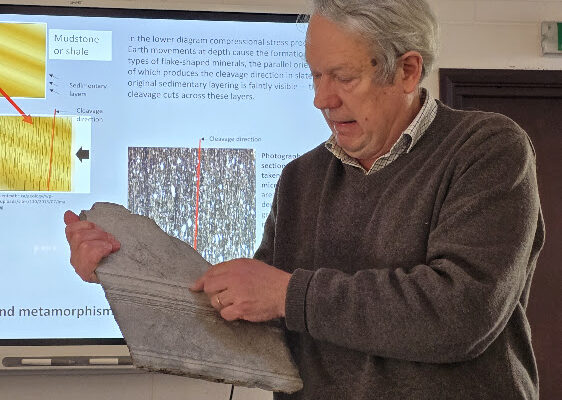
It stands to reason that our native rock and slate have always been hugely important to Cumbria – today visitors admire the landscape created by geological processes, but Cumbria and the Lake District were once an industrial powerhouse, with evidence of this industrial heritage evident all across the county if you know where to look and what to look for: redundant slate- and stone-quarries; copper and lead mines; blast furnaces; ironworks; coal-mining complexes; gunpowder works; bobbin mills; tanneries – the list is endless!
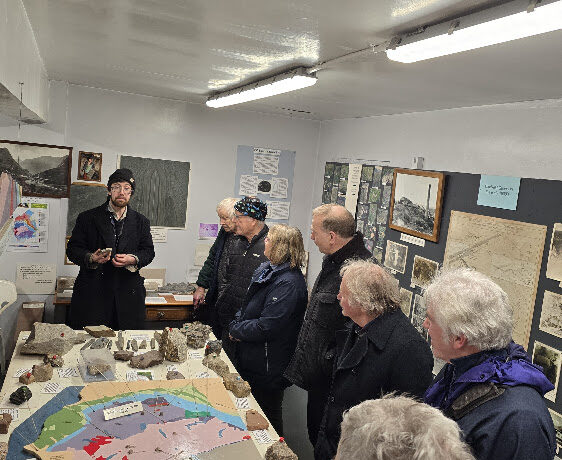
The microgranite quarry was opened in 1862 by Berlin-born Herman Harkewitz to supply railway ballast to the Penrith – Keswick line, and stone was sent across the country by train. Amongst other things it was used for over the years were roadstone and kerbs, and some of the granite chippings were fed into the tarmacadam plant, where they were heated and dried in rotating ovens before being coated in hot tar. The site finally closed in 1982. Thirty years ago, a group of people decided to open a museum dedicated to what Assistant Engineer and Museum Guide Dickon Chaplin-Brice described as “the dark and dirty side of the Lake District” during an enlightening talk about the site’s past and future – it is planned for the museum to move into a brand-new building in April 2026, complete with café.
We spent the afternoon at the Threlkeld Quarry and Mining Museum on the other side of the A66 – which for much of its length follows the route of the long- gone Penrith – Keswick railway line built to assist in the transportation of pig iron and raw ore produced in West Cumberland to Durham and Yorkshire for use by the steel industries, and coal from the Durham coalfield to West Cumberland.
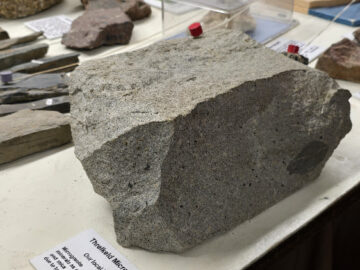
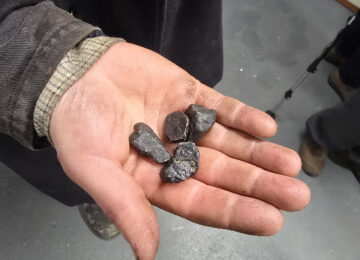
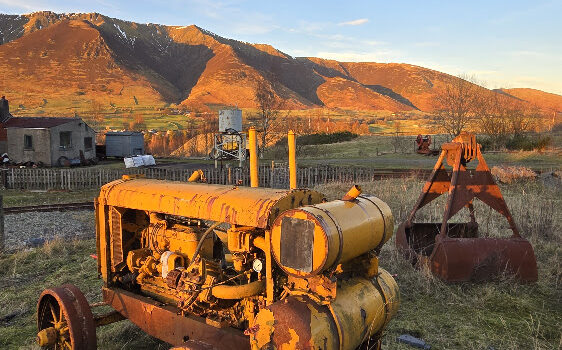
After a highlights tour of the geology and quarry rooms with Danny, we ventured out into the quarry site itself – a true highlight of the day. It’s
always a very special experience when you have the opportunity to see a distinctive fell like Blencathra from a different perspective – in this case from amongst the museum’s unique collection of vintage excavators and old quarry machinery!
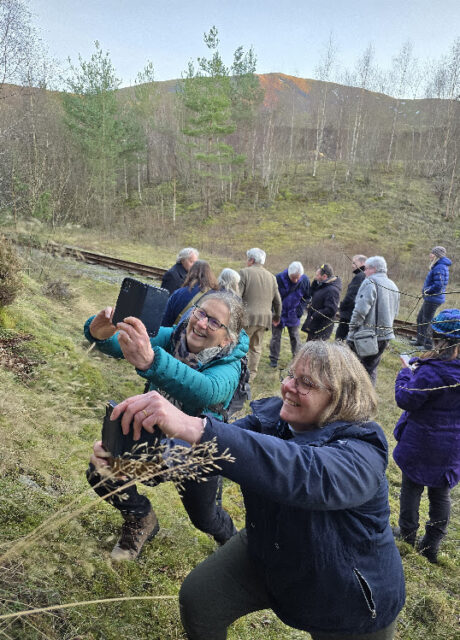
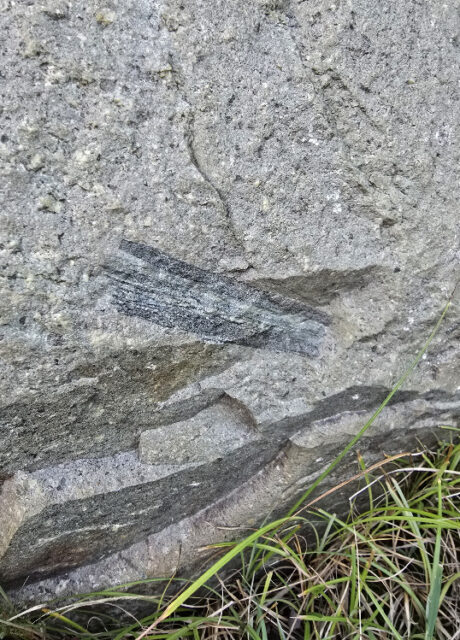
I hope to return on one of the excavator weekends on 17th/18th May or 20th/21st September so that I can take a ride into the inner quarry on the re-laid 2” gauge mineral railway, but an absolute highlight of our geology day was seeing a couple of things that are geologically pretty unusual: “xenoliths” in the microgranite at the edge of the quarry and contacts between the Skiddaw slate and the microgranite.
And now I’ve seen it with my own eyes, a “xenolith” is no longer Greek to me either! If you put the Greek words xenos and lithos together, they translate to “foreign stone” – in this case a rock fragment of a different type has become embedded in the microgranite during the cooling of the volcanic magma.

About author

About Author
Tess Pike
Tess Pike is a qualified guide for Cumbria, Yorkshire, North East England, and Liverpool City Region. She speaks English and fluent German.
She loves her job as much today as she did 30 years ago, when she first trained in Cumbria. She sees guides as storytellers, who weave the history, geology, literature, legends, and landscapes of a place into an engaging commentary. She enjoys introducing visitors to destinations and landscapes that they may already feel they know through books or film.
She lives in Kirkby Lonsdale – well placed to welcome visitors to the Lake District and Yorkshire Dales National Parks.
Email. Tess.Pike@btinternet.com
Other posts by Tess Pike