
No products in the cart.
Return To Shop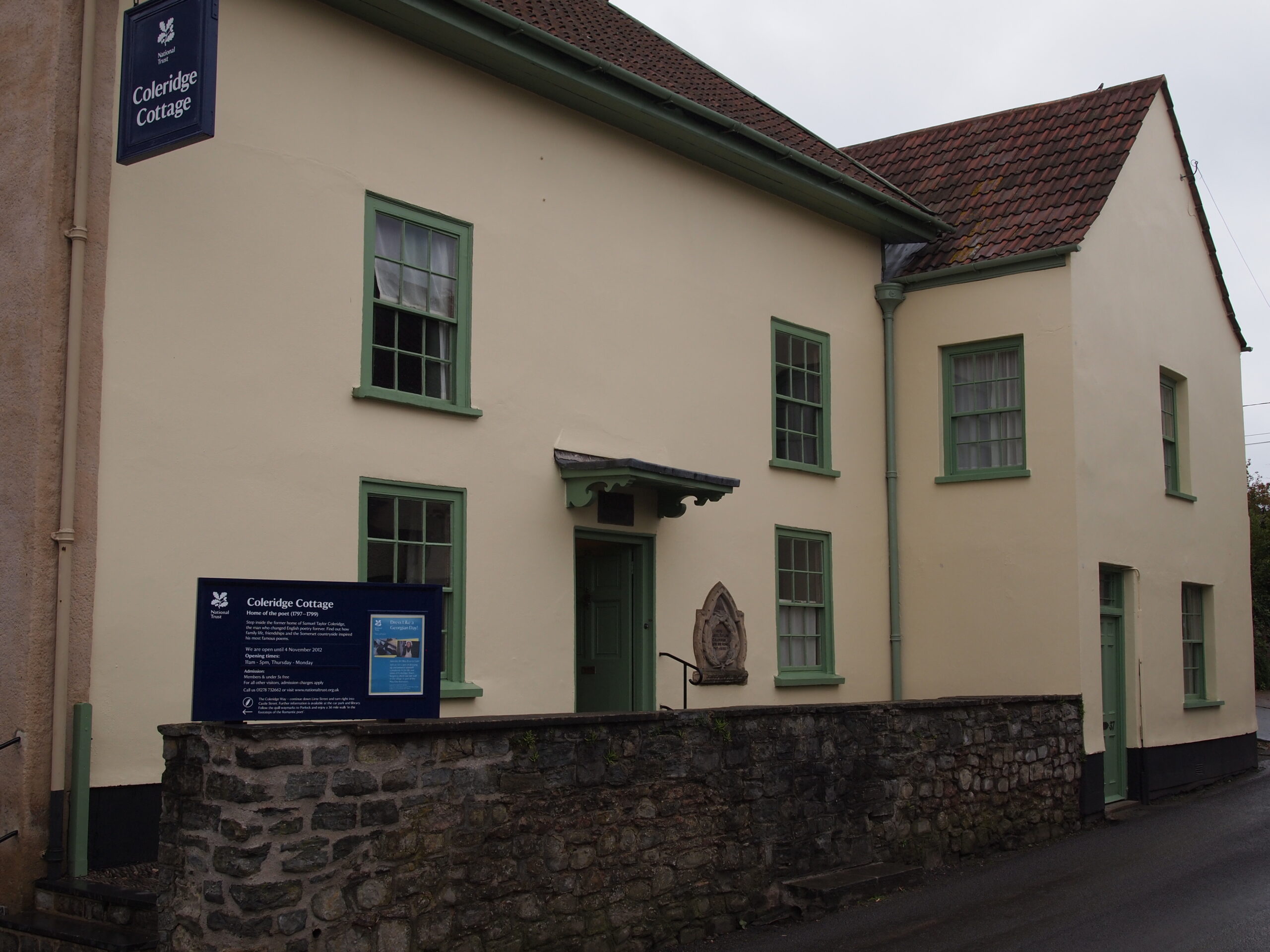
I had spent Easter in the Midlands, and was on my way down to enjoy a couple of days with a friend in Devon before returning to Cumbria at the end of Easter week. Unusually, I was ahead of schedule, the M5 was trouble free, so I had a couple of hours to take in something of interest on the way. I pulled out my National Trust property guide for some ideas* ….. and there was my answer: Coleridge Cottage in Nether Stowey. Barely half an hour’s drive from the M5 at Bridgwater in Somerset.

Just a couple of weeks previously, I’d enjoyed a fascinating visit to Greta Hall in Keswick, where Coleridge and family moved in 1799, after leaving Nether Stowey. It was a perfect fit.
Samuel Taylor Coleridge was born in Devon. Educated in London after his father died, he was often homesick, as he would recall in his poem, ‘Frost at Midnight’. He was an undergraduate at Jesus College, Cambridge, but left before completing his degree, and went to live in Bristol. His speeches soon became notorious, supporting the ideas behind the French Revolution that was currently raging on the other side of the English Channel, and speaking out against slavery in Bristol, a city grown rich from the slave trade.
While in Bristol, Coleridge became friends with another young poet, Robert Southey, and together they planned to emigrate to America to found an agrarian, communistic society which they named ‘Pantisocracy’. They married a pair of sisters, Sara and Edith Fricker, to advance this plan. Nothing came of it, however, and on the very last day of 1796, 24 year-old Coleridge, Sara and their 3-month old son Hartley moved to a cottage in Nether Stowey, Somerset. It was a freezing, mouse-infested “hovel” deep in the countryside.
The people of rural Somerset were suspicious of this alarming, eccentric young man who took long walks for fun along their trackways, lanes, and alongside their streams, at a time when walking recreationally was unheard of. A rumour went round that he was researching a route for the French to invade Britain via the inlets of the Bristol Channel. In fact, he was finding inspiration from the beautiful landscape and its people for some of his most famous poetry.
Together with his friend William Wordsworth, who also moved briefly to the area with his sister Dorothy, they began work on the Lyrical Ballads in 1798. This collection is often identified as the start of English Romantic poetry, and opens with Coleridge’s poetic masterpiece, ‘The Rime of the Ancient Mariner’, which is believed to have been inspired by nearby Watchet harbour. ‘Kubla Khan’, the product of laudanum-soaked dreams, was famously interrupted in full creative flow by a “person from Porlock”, and ‘Frost at Midnight’ beautifully describes the interior of the Cottage in Nether Stowey on a cold winter’s night, with frost creeping patterns over the window pane.
Coleridge, Wordsworth and his sister Dorothy made their famous journey up the Wye valley from Nether Stowey in 1798, resulting in Wordsworth’s famous poem, Tintern Abbey. Wordsworth was a frequent visitor to the Wye valley later in his life, when his “in-laws”, the Hutchinsons, moved there.
Coleridge’s doomed family life, revealed through the rooms of Coleridge Cottage, and an increasingly debilitating addiction to laudanum, meant he never regained the success of his time in Nether Stowey. Those three extraordinary years, and the poems that came from them, inspired generations of poets, artists, filmmakers, musicians, and even video game-makers. Coleridge Cottage is where it all began. On the 19th December 1799 Coleridge and his family left the Cottage at ‘Stowey’, to go and live in the Lake District.
The Cottage was acquired by the National Trust in August 1909. For 100 years it was lived in by custodians, who managed the Cottage and opened a limited number of rooms. In 2011, a big restoration project took place, recovering the Georgian features in the original rooms, and returning the Cottage to what it may have looked like when Coleridge lived there. Coleridge Cottage is a house of many faces. Bigger than it looks from the outside, its outer shell holds traces of its many lives as a 17th century “hovel”, Victorian pub, and 20th century home. Despite its many transformations, the restoration project in 2011 recovered the features of the cottage that Coleridge and his family would have recognised in the late 1700s. These include the original fireplace, where a fire still flickers in the winter months, and where Coleridge wrote his poetry. The 16-foot deep well, from which the family would have drawn their water, is still present.
My own special memories of visiting the cottage were of sitting in a comfortable armchair listening to excellent readings of Coleridge’s most famous poems, and the delightful little teashop, where the volunteers came to look for me in the garden since they were about to close, and thought I needed a cuppa! They were right.
Definitely the National Trust at its best, and a “must” for enthusiasts of romantic poetry who have an interest in the extraordinary lives led by the Lakes Poets.
* The National Trust runs several properties in and around Cumbria associated with William Wordsworth, including Wordsworth House in Cockermouth (his birthplace), and Allan Bank in Grasmere. Not owned by the NT but open to the public are Rydal Mount in Rydal and Dove Cottage and the Wordsworth Museum in Grasmere.
About author
