
No products in the cart.
Return To Shop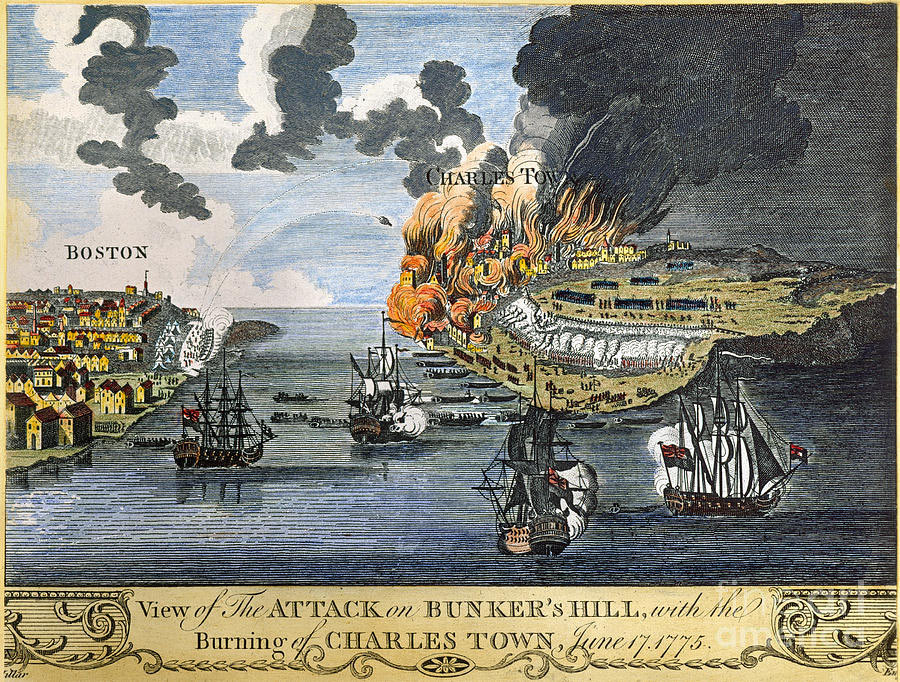
Near Greystoke there are two ‘folly farms’ – castellated buildings with high walls that resemble fortresses. They bear the names of Bunkers Hill Farm and Fort Putnam. For a long time, I wondered how these farms had acquired their unusual names and imposing architecture. Whilst preparing for the Greystoke CPD day, I delved into the history of these farms to discover they had been built by Charles Howard of Greystoke Castle (11th Duke of Norfolk) in the 1780s.

Bunker’s Hill Farm by Peter McDermot.
The dates and names are significant because they tie in with the American War of Independence1. The hostilities began in and around Boston in Massachusetts and lasted from 1775 to 1783. But how did two farms in north Cumbria end up bearing names associated with events that happened thousands of miles away and why?
I’ve just returned from a 3-week tour of New England and spent several days in Boston exploring aspects of the War. We walked the Freedom Trail – visiting various sites to understand the events that led up to the outbreak of hostilities. The colonists were resentful at the imposition of what they saw as unfair taxes and treatment by the British and the slogan of ‘Taxation without representation is tyranny’ became a rallying cry for the Patriots.
In response, the British stationed two regiments of soldiers in Boston to quell the growing dissent. On 5 March 1770, that anger simmered over when soldiers fired upon a taunting crowd, shooting dead 5 Bostonians − an event that became known as the Boston Massacre. Three years later, in an act of defiance against the unpopular tea tax, a group of colonists disguised as Mohawk Indians boarded three ships and dumped 342 chests of tea into the harbour – an act that goes down in the annals of history as the Boston Tea Party.
These events set in motion a chain of events that culminated in the start of the Revolutionary War in 1775. By mid-June, the colonists were determined to oppose the British troops now mustering in Boston. Taking control of a hill overlooking Charlestown2, they dug themselves an earth redoubt to hold the ground and waited for the British attack.
It came the following morning on 17 June 1775. The colonists were pounded by cannon and gunfire but were given instructions to hold fire until they could see ‘the whites of their [enemy’s] eyes’ − a tactic that resulted in the British sustaining heavy casualties. A second assault also repelled the British advance, but by the time of the third attack, the colonists had run out of ammunition and were eventually overcome.
The British had prevailed but at great cost. ‘A hill too dearly bought’ commented General Clinton on the loss of nearly half of his men. It was a pyrrhic victory, but the colonists were heartened at how long they had kept the well-equipped and highly disciplined British army at bay and this gave them renewed confidence to continue the fight for independence – ultimately forcing the British out of Boston in March 17763.
Fort Putnam, the other Greystoke farm, is named after a real fort at West Point (north of New York). It was one of a chain of forts built in 1778 to block British naval vessels from accessing Canada along the Hudson River.
On the face of it, you would think that Charles Howard would name his farms after decisive British victories or pro-British places, but this does not seem to have been the case. Although a supporter of George III, he apparently did not support the war with the American colonies. Maybe he had commercial interests in the new colonies that would be damaged by the war, or maybe Bunkers Hill Farm and Fort Putnam were so-named as reminders that with war comes a terrible cost. I’m only surmising here, so if anyone knows more about the reasons behind the naming of these two farms, I would be very pleased to hear from you.
On the face of it, you would think that Charles Howard would name his farms after decisive British victories or pro-British places, but this does not seem to have been the case. Although a supporter of George III, he apparently did not support the war with the American colonies. Maybe he had commercial interests in the new colonies that would be damaged by the war, or maybe Bunkers Hill Farm and Fort Putnam were so-named as reminders that with war comes a terrible cost. I’m only surmising here, so if anyone knows more about the reasons behind the naming of these two farms, I would be very pleased to hear from you.
Anna Gray, Nov 2018
Notes
1 Or the Revolutionary War as the Americans prefer to call it.
2 The Battle of Bunker Hill is something of a misnomer as the fortified area was actually on Breed’s Hill to the south, but the name of Bunker Hill stuck.
3 The American War of Independence formally ended on 3 September 1783.
About author
