
No products in the cart.
Return To Shop
Cumbria Blue Badge Guides regularly take part in a series of learning activities to refresh and enhance our knowledge. We recently enjoyed a day out in Keswick exploring the Arts & Crafts highlights in this beautiful Lake District town.
Our venue for the morning was Keswick Museum. For those of you who have not visited this museum, you are missing a treat. Only a small venue but it packs a punch in terms of the exhibits housed within its walls; collections focus on social and industrial history, geology and the natural environment and the work of local craftspeople, writers and artists. The museum was established in 1882 and opened to the public in 1898, thus celebrating its 125th anniversary in 2023. It was the earliest purpose-built museum in Cumbria.
The first speaker of the day was Chris Pratt, a volunteer at the museum, who has a particular interest in work produced by the Keswick School of Industrial Arts (KSIA). This organisation was set up by Canon Hardwicke Rawnsley (a local Victorian clergyman and campaigner, described apparently by one of his parishioners as ‘the most active volcano in Europe’) and his wife Edith, offering practical “craft courses” to the working-class people as a means of teaching them skills they could use during the winter months, when unemployment was high, to make items that could be sold to visitors during the summer.
KSIA’s ethos and design were influenced by the Arts & Crafts movement, which began as a “reaction” to the industrialised and cluttered lives in Victorian times and had its heyday during the years from approximately 1880 to 1930. The movement placed value on local materials worked by hand to create items not just of beauty, but which were also functional.

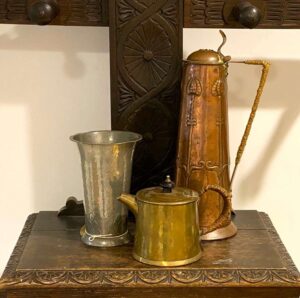

Chris had brought along a selection of items from the museum collections, as well as some of his own treasures – see above, for examples – showing the attention to detail which is so distinctive in arts and crafts pieces and which makes them still so appealing to this day.
Our second speaker, Peter Hughes, is lucky enough to live in a local Arts & Crafts House. Peter gave a fascinating talk about how an architect’s drawing of the house and proposed garden, published in the Studio Yearbook in 1908, put him on a journey of discovery.
The group enjoyed lunch, provided by Café West, based at the museum. Café West offers valuable training and work experience opportunities for young people and adults with learning difficulties and is run as a social enterprise.
The afternoon session was a delightful walk through parts of Keswick, exploring further links to the Arts & Crafts movement. Our first stop was in Fitz Park itself for a quick look at oak trees – of which there are three main types: English, Sessile and Holm, all important as the main choice of wood used in Arts & Crafts work. Crossing over the River Greta we made our way to Greta Hamlet.
This is a group of 25 houses which was built in 1910 by the Derwentwater Tenants Co-Partnership, which gave people a chance to get on the property ladder as they could own part of the building and rent the rest. The houses are built round a central court and are in the spirit of the “Garden City” movement, the inspiration of a local Quaker, Anthony Bagster Wilson.
We made our way to the Crosthwaite Parish Rooms, original home of the KSIA. A beautiful building that is still used today by a variety of community groups. KSIA was inspired by John Ruskin’s ideology, offering nature and craft as an “escape” from the hard working and living conditions endured by many at that time.

Next stop, the KSIA workshop building – see above – which also had a shop/showroom on the first floor and was built using local materials and echoing traditional Lakeland building styles.
Our final destination was Crosthwaite Parish Church, dedicated to St Kentigern (also known as St Mungo in Scotland). There has been a place of worship on this site since the 500s and is one of Cumbria’s oldest churches, dating back to 1523. The church has lovely examples of KSIA light fittings, Charles Kemp Victorian stained glass and reredos, gates, pulpit and altar front designed by Edith Rawnsley. Slightly more unusual items include the door bolt and the Baptistry dedicated to Canon Rawnsley and his wife Edith, as well as small fragments of medieval glass. There is a memorial to Robert Southey inside the church, and his grave can be found outside. (This has been restored by the Brazilian Government, ‘in gratitude for’ Southey’s 3-volume ‘History of Brazil’.)
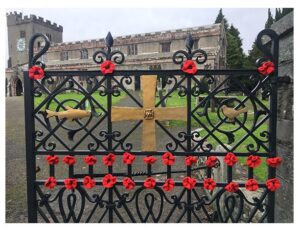
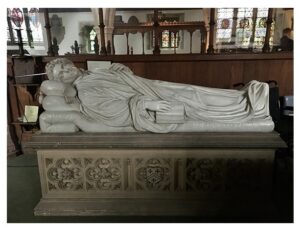
A fascinating day exploring some of the lesser known facts and sites of Keswick.
Written by: Alison Shaw
Photography: Gordon Lightburn & Teresa Williams
About author

About Author
Alison Shaw
Alison is a qualified Blue Badge Tourist Guide for Cumbria and has lived in the county for 20 years. She enjoys exploring this eclectic corner of the country, whether it is stunning coastline, castles, stately homes and gardens, or industrial heritage that has helped shape the landscape as we know it today, there is plenty to discover.
She enjoys meeting people and sharing her knowledge of the region with visitors and helping them to discover potential hidden gems and places that will make a visit memorable. Alison also enjoys the ongoing learning opportunities that being a Tourist Guide brings!
You can contact Alison by email, beyondthelakesedge@gmail.com, to discuss potential tours and outings.
Other posts by Alison Shaw