
No products in the cart.
Return To Shop
The small market town of Keswick is surrounded by a vast amphitheatre, 20 miles in circumference. The rural settlement has a lake – Derwentwater – 10 miles oblong with a variety of wooded islands; two rivers (the Greta and the Derwent); three parks and a rich, beautiful landscape. The population of the town is just over 5,000.
The Moot Hall (see photo below) in the centre of the perfect pedestrianised market place is an excellent place to start a guided walk. The Tourist Information Centre is housed here and it is surrounded by interesting shops, restaurants and pubs. The Alhambra Cinema is a short stroll. Fifteen minutes further is the Theatre by the Lake.

There are too many interesting places to list, but the Pencil Museum is a must. The first pencil mill dates back to 1566 when a rich deposit of graphite was found in a nearby valley. The graphite was used up (not just for pencils) by 1880, but pencil-making continued on this site until 2007.
Keswick Museum is award winning and situated in Fitz Park near the Threkeld railway walking trail.
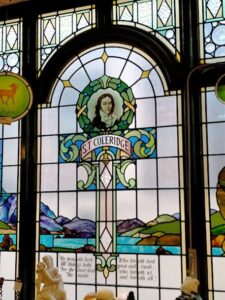
The Royal Oak public house, now a gift shop, has stained glass windows dedicated to the Lake Poets who visited. Samuel Taylor Coleridge (whose window is shown below) and Robert Southey lived on a hill overlooking the town at Greta Hall.
There are six churches, of varying denominations, and a Quaker Meeting House – the whole history of Christianity.
Almost 900 years ago the whole area was under monastic influence. The name Keswick originated from the time the Cistercian Monks of Furness Abbey specialised in cheese making in the then village. The presence of the region’s much loved Herdwick sheep is a result of Cistercian monks settling locally in the 12th century.
The Keswick Convention is an annual gathering of conservative evangelical Christians that meet annually – in 2023, this will be between the 5th July and 4th August.
Few towns, as small as Keswick, are able to boast of so many men and women who have contributed to the history of the town – miners, fell runners, photographers, engineers, map makers, an inventor, the first female journalist, poets, craftsmen and women, artists and a founder of the National Trust, our largest conservation charity.
Jonathan Otley (whose plaque is shown below) – seen by many as the father of English geology – lived in Keswick.

A guided town trail with a Blue Badge Tourist Guide will take you off the beaten track, down alleyways, along country footpaths to explore the geology and history of the town.
Keswick has many easy walks straight from the town centre, the most popular along the shores of the lake, Derwentwater, to Friars Crag, a rocky promontory that projects into the lake. Another is along an uphill track to Castle Rigg Stone a stone circle, estimated to date back to 3200 BC. The 38 stones of Skiddaw slate stand in a ring of approximately 30 metres diameter.
But how many visitors explore the history, heritage and geology of the town?
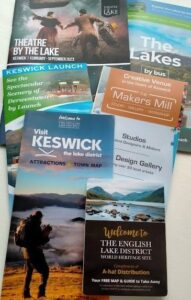
Maps, guide books and informative leaflets are available at the Tourist Information Centre; but for an entertaining and informative walking tour, choose a reliable and professionally qualified Blue Badge Tourist Guide – who will have local, up to date knowledge, and show you what makes this friendly Lake District town so special.
About author
