
No products in the cart.
Return To Shop
Keswick’s outstanding scenery has drawn visitors for over 300 years, amongst them some remarkable literary figures: Romantic poets Robert Southey and Samuel Taylor Coleridge, Thomas Gray and Thomas West authors of the first guides to the Lakes, Hugh Walpole the 20th century novelist and Canon Hardwicke Rawnsley, priest, author of hymns and poems, and co-founder of the National Trust.
Greta Hall (main picture) was the shared residence of the Southey and Coleridge families. From the front, it looks like a symmetrical Georgian house but closer study reveals that the original cottage and three-story tower (built as a viewing point) has been converted in something more elegant. Its early 19th century owner, William Jackson, was delighted at the prospect of distinguished literary tenants, and only too ready to expand the property to meet their needs: but he cut corners and recycled with abandon, creating problems which its 21st century occupants still find themselves dealing with.
It is still possible to identify how the rooms in the house were used by the two families. Pride of place must go to Robert Southey’s first-floor study with its great Venetian window and the view up Derwentwater to Borrowdale. Still lined wall-to-ceiling with Southey’s books, this room could tell stories of the contrast between the disciplined Southey, bearing the responsibility for both families, and the chaotic Coleridge, who was rarely at home. But most of the burden seems to have been borne by the housekeeper who “came with the house”. The uncomplaining Mrs Wilson cooked, cleaned, and laundered – much of the time surrounded by the children – and held everything together on a totally inadequate budget until her late 70s. It must have been a madhouse.
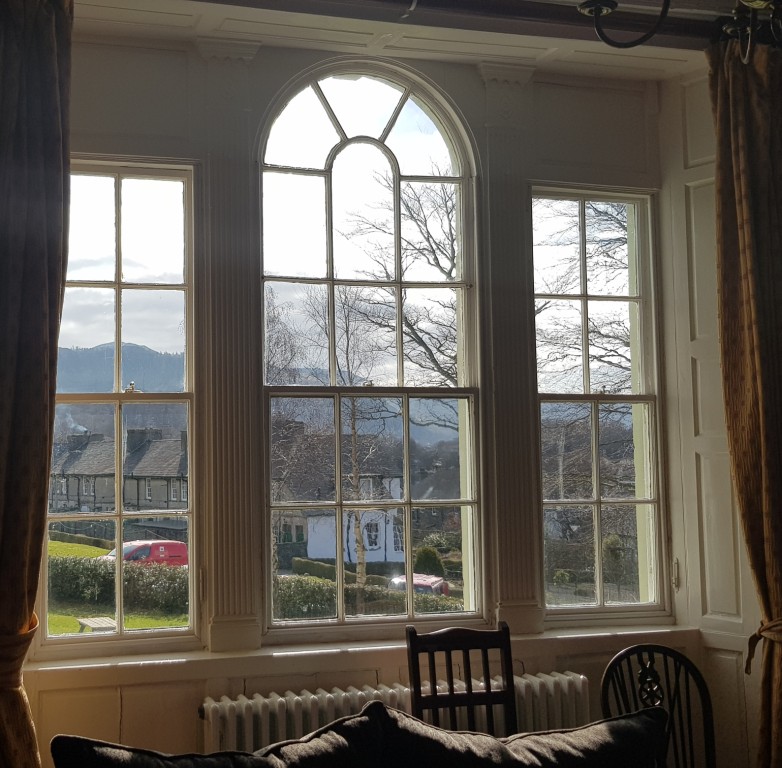
Photo: Peter MacGowan
Today, Greta Hall provides self-catering accommodation and conference facilities and is not open to the public but the owners are open to approaches from groups with specific Southey/Coleridge interests and will do their best to make a visit possible.
St Kentigern’s church at Crosthwaite dates back almost to the conquest and was for centuries the only church (as distinct from chapelry) in the Central Lakes. Sir George Gilbert-Scott’s 1844 restoration (new roof and embattlements) and subsequent work by C J Ferguson means that the building itself is not easy to fathom but its literary history is plain to see.
Canon Hardwicke Rawnsley was the incumbent for 33 years from 1884 to 1917. He had the reputation as a caring shepherd of his flock, though fitting this in alongside his hymn-writing and “Thunder[ing] out the gospel of the National Trust from a thousand platforms and pulpits up and down the country” must have been a challenge. The church furnishings owe much to the Rawnsleys and the Keswick School of Art which they founded. The churchyard contains a forest of Celtic-cross headstones, some designed by Edith Rawnsley: and inevitably the Canon’s grave along with his first and second wife (Edith and Eleanor) is so marked. Even the four Kentigern symbols on the churchyard gate (see footnote below) are reckoned to be Rawnsley’s work.
In purely literary terms, Robert Southey is perhaps the churchyard’s best-known occupant. His monument inside the church is a recumbent white marble figure “disturbingly awake” holding a book (the appeal to fund this was so successful that the excess funded much of Sir GG Scott’s restoration): his much plainer gravestone is in the churchyard. Its restoration in 1961 was funded by the Brazilian Embassy, in recognition of his multi-volume (but now little-read) history of that country.
One of Rawnsley’s predecessors was the Rev James Lynn and beside his tomb lies a ledger-stone in memory of his daughter, Eliza Lynn Linton. Those who know Brantwood (John Ruskin’s house at Coniston) may recall that Eliza and her husband W J Linton were his predecessors in that house. Eliza got fed up with her husband’s “fecklessness and domestic chaos” and left him to become the first successful English woman journalist, a prominent novelist and (simultaneously if paradoxically) a pioneer of female emancipation and an attacker of feminism. A female member of our group repaid debts owed to this pioneer with a vigorous scrubbing-off of the moss which threatened to obscure her memory.
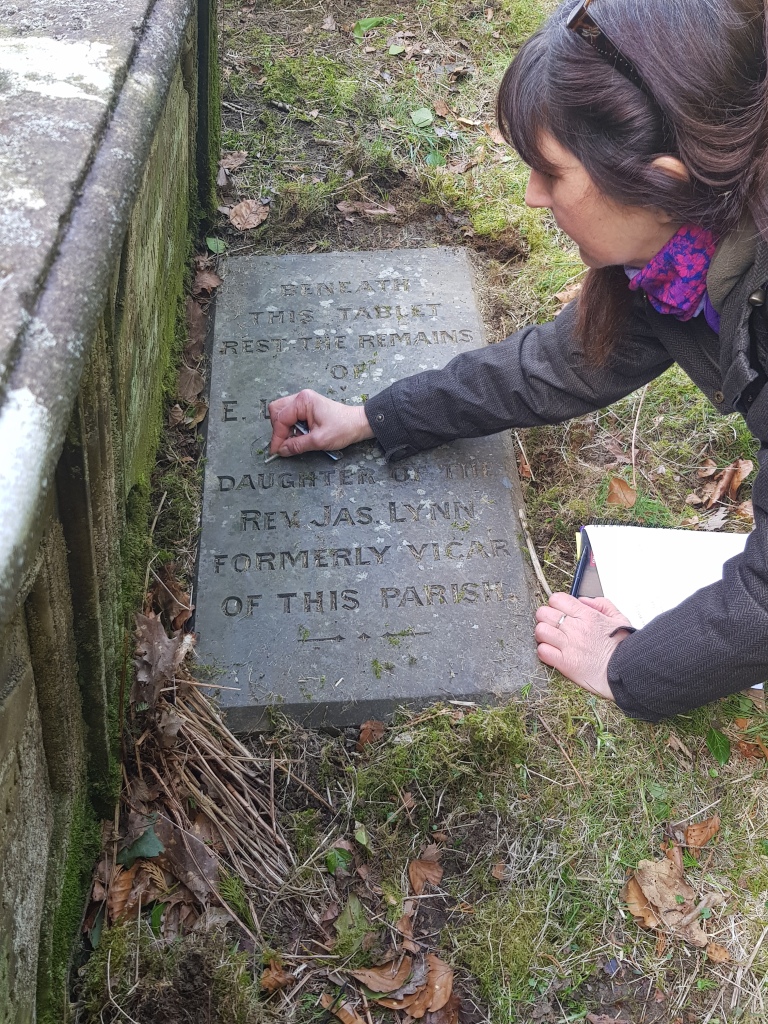
Photo: Peter MacGowan
Rawnsley lived at the Old Vicarage (not open to the public) which enjoys a stupendous view. Thomas Gray was one of the first to note this in 1769 and a slate slab (the original installed by Rawnsley and – since it had been damaged – a replacement by the current owners) records his description of the scene (in a letter to Thomas Warton) as “the sweetest scene I can yet discover in point of pastoral beauty”.
After lunch, our focus moved to Derwentwater, starting at Crow Park. Gray had admired the sunset here in 1769 and Thomas West (who told his readers where to find the best views by identifying “stations”) identified Crow Park as his second Derwentwater station. Actually, Crow Park doesn’t quite meet all the desiderata of a perfect station, for the bossy West says that “one should be looking at the view from a slight elevation”, as we were to see at Castle Head a little later on.
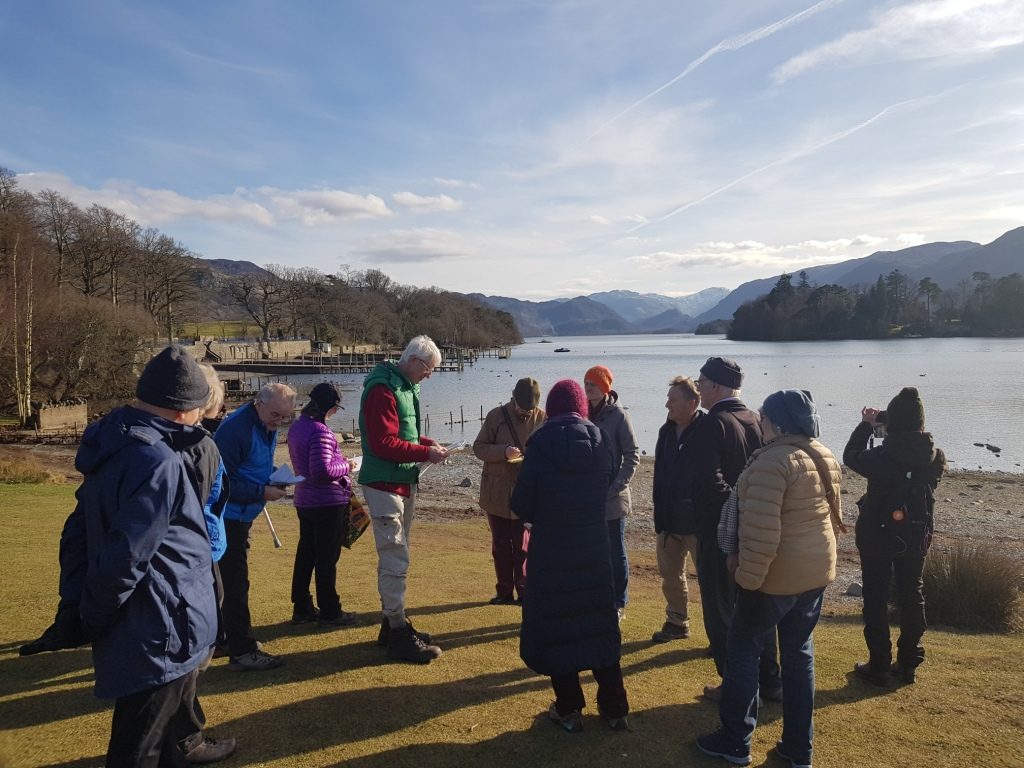
Photo: Peter MacGowan
Calf Close Bay on Derwentwater’s western shore looks out at Friar’s Crag. A great viewpoint as noted by John Ruskin, Victorian polymath, art critic and social reformer, who recalled being taken there by his nurse as the “first event in life.” Fittingly, Friar’s Crag was given to the National Trust in 1922 in memory of Hardwicke Rawnsley. Across the lake is Catbells and just a little to the south, Derwent Island and its house built by that great promoter of Keswick “Captain” Joseph Pocklington house with its “picturesque created landscape”, stone circle, follies and all.
In October 1769, Thomas Gray had looked across the lake from Calf Close Bay through his “Claude glass”, a curious mirror-arrangement which enabled the viewer to “frame” the view in the approved manner (the 18th century equivalent of the “selfie”). He looked through reeds across the lake: but the reeds are no more and we stood on a shingle foreshore, wondering about beach erosion, the importance of reed-beds in preventing it, and what might have happened here.
The last viewpoint of the day (and what a note on which to end) was up the hill at Castle Head, West’s third Derwentwater station (no problems about insufficient height with this one). A magnificent late afternoon view across the lake through the Jaws of Borrowdale to the high fells beyond, all of which brought those literary figures here in the first place.
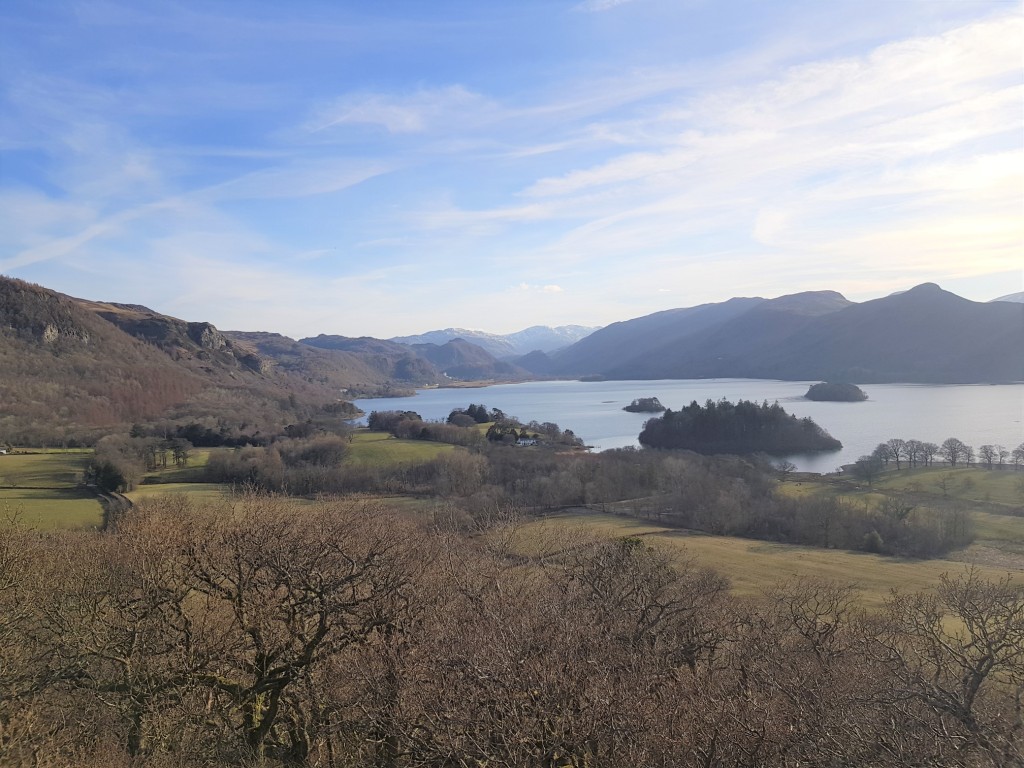
Photo: Peter MacGowan
Footnote
St Kentigern is known in Scotland as Saint Mungo, and performed four miracles in Glasgow. The following verse remembers them:
Here is the bird that never flew
Here is the tree that never grew
Here is the bell that never rang
Here is the fish that never swam.
And all four of are there on the church gate at Crosthwaite.
About author
