
No products in the cart.
Return To Shop
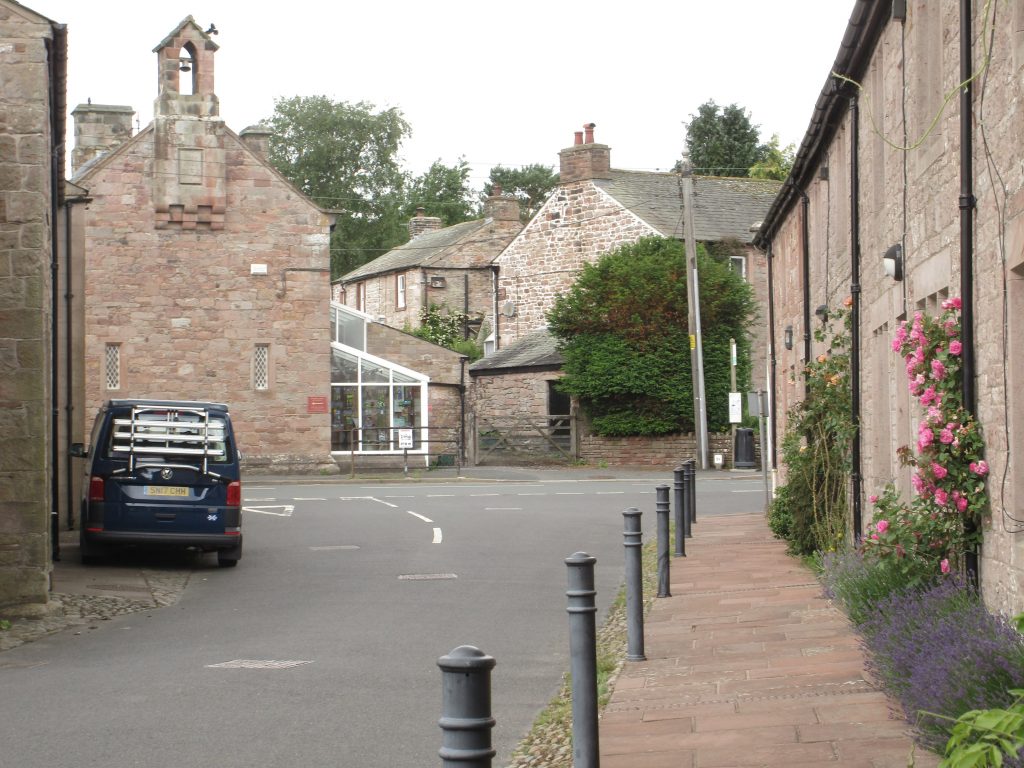
Just a couple of miles north of the A66 is a village close to my heart and home. The buildings are mostly pretty pink sandstone and it has all that a visitor could wish for – post office and shop, pub, village hall, church and castle, even an open air swimming pool. The village – Greystoke – is a perfect estate village that has been associated with the Greystoke, Dacre and the Howard families for hundreds of years.
Thinking I knew almost everything about Greystoke and the surrounding area, I arrived at the Boot and Shoe, a traditional family-owned village pub with B&B, wondering what I would discover if I explored the village and the surrounding area with fresh eyes …
Were this village within the boundary of the Lake District National Park it would be swarming with visitors. Situated just a few miles beyond the main route to Keswick and the Western Lakes, it is generally bypassed. Visitors are normally cyclists (it is on the CtoC bicycle route) or horse lovers (Nicky Richards horse racing stables are within the village margins) or, increasingly, visitors to the informal Cycle Café, which is also the venue for a range of quirky workshops ).
The place name Greystoke goes back to the Anglo-Saxon “Creikstak” which meant either the place of the badger or the place of the meandering stream. Originally Greystoke was within the boundaries of Inglewood Forest which stretched from Scotland into this northern part of England. We can imagine that it was a place where wild beasts roamed and into which marauding people from the north made frequent raids. Thus castles came to be built as strongholds against invaders.
A Roman encampment at Berrier Hill, later a wooden motte and bailey castle, contributed to making this a historic site. Today Greystoke Castle sits behind a high wall and it was in 1353 that William, Lord Greystoke was licensed by Edward III to crenellate a tower here.
The Castle and Estate are now in the care of Neville Howard.
The first “Lord” to build a manor house at Greystoke, by grant of the king, was one Lyulph or Sigulf of Viking descent – note the local names of Ullswater and Lyulph’s Tower. Thus began the barony which descended over the centuries through four “Houses”.
Blencowe Hall has two fortified pele towers linked by a two-storey hall. The name is from the Celtic blaenn “hill” and on haugr “hill” and the Hall sustained cannonball damage during the English Civil War (1642-1651) resulting in a split appearing in the front wall of the western tower. The abyss has been imaginatively filled with darkened glass as part of recent restoration and renovations and Blencowe Hall now offers luxurious self-catering accommodation by Rowley Estates. The history may be fascinating but mostly I loved the opportunity to explore the 12 bedrooms, 11 bathrooms, open plan kitchen and stunning interiors. There are three cottages for rent too.
Not far from Blencowe Hall is the former home of William Whitelaw (1918-1999) called Ennim. Lord Whitelaw was Home Secretary from 1979-1983, Leader of the House of Lords 1983-1988 and Deputy to Prime Minister, Maggie Thatcher. It is a quintessential country house set in five acres.
And, on the road to Penrith, you’ll find the Clickham Inn. This is a former drovers’ inn situated on what is most likely a droving route from a major cattle fair at Rosley to Newbiggin or Penrith. The name derives from the practice of clicking or counting in the drovers’ cattle on arrival.
Elsewhere in Greystoke village, stones, follies and houses with delusions of castle grandeur seem to be common themes.
On Church Road is a Sanctuary Stone – purple coloured whinstone (probably a glacial erratic) with a hatchet mark pointing to St Andrews Church. This is where fugitives would find sanctuary within the precincts of the church. The stone once stood in the middle of a “causeway” leading to the church but was moved to its current (almost hidden) position in 1969. The headwaters of the River Petteril wind through the village before heading north to Carlisle.
A Plague Stone sits in a field on a path leading from the church. The hollowed middle is where plague sufferers would leave money in payment for food. The hollow was filled with vinegar that acted as a disinfectant.
Of the follies, Spire House is a farm with a spire built by Charles Howard, 11th Duke of Norfolk, around 1783 to 1789 in jest against a tenant who did not believe in the need to worship in church. Allegedly, the spire was erected while the tenant was away in Edinburgh.
The farm buildings of Bunkers Farm are castellated and it is named after the first major battle during the American War of Independence on 17th June 1775. Today, the farm is selling unpasteurised milk from the farm gate – six hours from cow to consumer.
Fort Putnam Farm, also castellated farm, is named after General Rufus Putnam and it has a high seven-sided wall surrounding the farm buildings. The real Fort Putnam, built in 1778 at West Point north of New York City, was one of a chain of forts protecting supplies passing along the Hudson River. The fort blockaded British Naval vessels accessing Canada during the American Revolution.
Behind Greystoke Castle walls is another “folly”. Stafford House was constructed for the head gardener of the Greystoke Estate. The house is Gothic in style with battlements, pointed windows upstairs, rounded arches below and a church window. Stafford House is one of the 11th Duke’s architectural jokes and is peacefully located within the grounds of the castle.
The gardens on the estate are in the capable hands of Ian Corrie, who designed the borders at Hutton in the Forest with Lady Inglewood whilst he was the gardener there. Hutton in the Forest is a historic house that lies just over four miles from Greystoke village. The house features six periods of time ranging from the mid 14th and the mid 19th centuries and is a rich illustration of the development of the country house in the North of England. I’d recommend a visit to the walled garden and it is also the venue for Potfest in the Park late each July.
Did I forget to explain that Tarzan reference?
Tarzan, son of Lord and Lady Greystoke, was born in the African jungle in 1888. Edgar Rice Burroughs’ story and the sequels to his novel have sold millions of copies in many languages and been the source of several films too. Local tradition has it that he met Cecil Spring Rice in China, the writer of the lyrics of the well-known hymn and poem “I vow to thee my country” and, at that time, Ambassador to China. Cecil’s home was at Watermillock near Ullswater and he talked to Edgar Rice Burroughs about Greystoke Castle and the intriguing stories of the Howard family – and the rest is history!
But, if you think there is nothing more to Greystoke than Tarzan, I’d recommend a visit to the village and its surrounds.
About author
